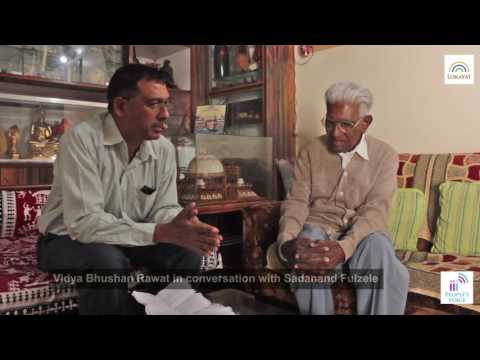
‘It is good to break and bad to continue with a tradition that has subjugated the Dalits’
By Vidya Bhushan Rawat
Mr Bhagwan Das is one of the most reputed scholar on Ambedkarism and the issue of Human Rights of Scheduled Castes. Widely traveled, Mr Bhagwan Das has spoken at various national & international platforms on the conditions of Dalits in India and what is the best way of their emancipation. In freewheeling conversation with Vidya Bhushan Rawat, he speak of the state of Dalit movement as well as political parties in India.
Please tell us about your childhood? Being son of a sweeper, what hurdles and obstacles you faced with and how did your father react to them.
My childhood was different. My father came from well off family. After the death of his father, differences occurred in the family and he came to live near Simla. He was not educated, as he could not go to school. My father worked as a sweeper in the post office. He had a house of his own and saved money regularly. He loved reading and had deep interest in Ayurveda. He took special care to educate my sister and me. A Maulvi was kept to teach us. So it was different unlike other untouchable families of time where education was not considered important. He was financially well off and spend most of the time with his books.
In my native village untouchability was practiced in turning on the taps. The barbar did not cut my hair; we could not enter a temple. We had to ask Hindu boys to give us water whenever we had to drink it but since my family was well off, we did not face any difficulty in this regard.
How did you come in touch with Dr Ambedkar?
Dr Ambedkar, then a labor minister visited Simla. I had read about Ambedkar particularly reading Urdu newspapers. He was our harbinger of Hope. We did not anything about him except all anti Ambedkar campaign in Congress papers was the same as in Hindu papers. The only exception I found Ambedkar in Hindi newspapers was Kranti by Sant Ram BA.of Jaat Paat Todak Mandal.
I went to meet him for the first time as I waited for him for three hours because I was first a boy, all the people holding important position came and went away, At 7 pm I was taken inside his house. He looked at my face. I did not go to ask for anything from him but he said ‘ What do you want?’ “ I do not want anything, as I was already employed, I said. I told him about my family and about my applications. In 15 days, I got a letter of appointment. This time my boss was a Muslim. It was surprising that I found that most of the Muslims were terribly against me. Some of the Hindus were very helpful and progressive. Some of them were South Indian Brahmins and I found them quite progressive but Matlab Hussain, my immediate boss, had some complaint against me as I was overburdened with my work. I used to work till 7.30 pm. Everybody tried to exploit me. I left that job and joined Indian Air Force. I did not want to join army but navy appealed to me.
I was again selected for further training to UK but I had to deposit Rs 5000/- which I could not do that and left Air Force in 1946 and went back to my family in Simla. There I was working with Scheduled Caste Federation and I came across very progressive people belonging to the communist parties, and one very progressive in the party was Kameshwar pandit. There we read a lot of Marxist literature and also learnt about Chinese experiment. I read about Mao Se Tung but who appealed to me was Le Su Tse.
We used to hold study circle meeting. I was staying at Seva Nagar, in Delhi. It was a peon’s house where I stayed for two years, as I could not afford a better one. Then I shifted to Lodi Colony with a friend who was an ex communist. He was thrown out of the party. He had been a whole timer. He was very fond of reading, not just Marxist literature but general reading. Later, I was allotted house in Sarojini Nagar.
Here, I came in touch with Mr Shiv Dayal Singh Chaursia, a backward caste person and a few others who were working with him in the movement. I used to spend out time in Gandhi Peace Library. Chaurasia wrote a note of dissent in the backward classes commission. He took me to show the note of dissent, which was actually drafted by me to Dr Ambedkar. Dr Ambedkar did not have a high opinion about that note. He asked to keep the note for his comment but started putting questions about me. He had forgotten that he had met me earlier. I spoke most of the time in English and offered to work for him. It was three days in a week to which he agreed. Some times, he wanted to information/abstract about certain books for which I used to go to Library. But after the work was over, I used to sit with Dr Ambedkar for 10 minutes and put my questions.
What would you discuss with Dr Ambedkar? What would he say to the issue of such as conversion as he was promoting a particular idea of embracing Buddhism? What actually was your position on it? Why should not we convert to any other faith of our choice? Unfortunately, caste system goes along with you even after conversion? What choices do we have to save us from the oppression and exploitation of caste system?
One of the questions was on Buddhism as he was always asking us to embrace Buddhism. I asked that I could not enter a Buddha Vihar. How do you say Buddhism is better than any other religion? I have been to Burma, seen Tibetan Buddhism but have not come anything worthwhile. Study is different but as long as social practice is concern, I do not find anything different in it.” Ambedkar replied, ‘all you said might be right whether I studied Buddhism or not. Now onwards it would not happen again. Since I studied a lot books on Buddhism and since I studied books on religion particularly Hinduism, Islam, Christianity, Sikkhism, Kadianis etc, but Marxism and Buddhism attracted me the most. About Sikhism, I have a very poor opinion. I came close to them because I was teaching two children belonging to them. One of the students father was a doctor, who used to invite me to Gurudwara. I used to go there. Then there was one festival on which they had a langer (community meal) in the Gurudwara. One man asked the doctor; ‘you are making us eat with the Churas and Chamars.’ It was a shocking experience for me in the Gurudwara. After it I studied Sikhism and found that they had 10 Gurus, all belonging to the Khatri caste, none married outside their own parental castes and the fourth guru included teaching of Ravidas, Kabir and others in the Guru Granth Sahib but in practice Sikhism is no different from Hinduism. If a convert comes from Carpenter community, he is a Ramgarhia, if is he a convert from scavenger then he is a Majhabi, if he is a convert from liquor seller then is an Ahaluwalia. Where is the caste system gone? If goes from the front door and comes back from windows. They never started a movement to condemn caste system. After that incident, I never went to a Gurudwara.
I was still critical of Buddhism but felt that if untouchable continue to follow the religion they have been following then there was no chance of their ever unifying. If Hinduism is preaching untouchability against their castes, these castes themselves practice untouchabiliity among themselves. Now for instance, if you go to a Chamar, he looks down upon sweeper and if you go to a sweeper, especially in north India to those who calls themselves as Balmikis, they will never do anything with Helas, doms and Mehtar. Because Valmiki movement started in 1930s and mainly started by Arya Samajis because they were converting to Christianity. One person Tetar was asking the Christians to convert them but the upper caste priests were not ready to convert them for the fear of losing the other people from the church.
Upper castes converted to Christianity after 1857. There were Muslims, Hindus who became Christians when the missionaries started converting the untouchables. They too had started going to church but the Holy Communion was a problem. The upper castes started their prayer meeting in the morning and the untouchables were told to conduct their church meetings in the afternoon. So Kashmir gate church had two services, one in the morning and other in the evening for untouchables.
I also found that people who were converting to Buddhism was just for the namesake. It is unique to India that even after leaving your religion and embracing the other religion they stick to their castes. You cannot get rid of your caste. Unfortunately, a majority of those converted to embrace Buddhism were Mahars hence Mangs were looked down upon by the Mahars as they did not bothered about Chambhars.
What were your impressions about Baba Saheb Ambedkar when you first met him.
My father used to talk proudly about him. The thing which impressed me very much when I first met him was his love for learning and second his character which was immaculately clean, his worst enemies could not charge him on this front and third his commitment to the cause of untouchables. But when I was working with him in the labor ministry, I found his involvement in developing this country. He sent six Scheduled Castes to UK who later held important positions in the central ministry. Besides the SCs, he was interested in the industrialization of the country after the British left.
A lot has been written about Ambedkar’s conversion to Buddhism. Many Dalit intellectuals interpreted it as his anti Marx philosophy. Where does Ambedkar Stand on Marx?
He was not anti Marxist but against dogmatic people because the books written by Dange and other upper caste elite Marxists did not appeal to him. But he studied Marxism seriously and also the labor movement of UK. He was much interested in modernizing India and that is why he introduced this thing when he was labor minister. If you go to his writings in parliament, it has inclination for progressive and modern thinking and that is a common link between Nehru and Ambedkar and which writers have not highlighted, as they have not done independent research. They had much respect for each other. Ambedkar was not a great admirer of Nehru when he joined the government but when he had opportunity to interact with Nehru he opinion was very much different.
What is your reaction to the state of Dalit Movement today? There are so many republican parties as well as different caste based organizations. Then there is political philosophy of BAMSEF and BSP. What do you think is the future?
When Ambedkar entered the field he started Independent Labor Party and in that he not only had untouchable leaders but leaders from other communities such as upper castes who joined the movement and the party. In 1940 he felt that it was not enough so he formed Scheduled Castes Federation and it was exclusively for the untouchables of India. After India’s independence he felt that SCF was meaningless hence he started Republican Party of India and it was not a party exclusively for the SC people. He wanted to broaden the base and take up the economic cause for advancement of India but people who took over the leadership of RPI did not understand him and did not want to follow him. They wanted RPI for caste mobilization and hence it split on caste lines. Today there are so many wings of RPI that you do not even know.
You have been critical of BAMSEF? What were the basic differences that you found with them?
BAMSEF is not a political party. It says it is backward, SC and minority employees’ federation. If it is an employee federation than it is not a political party. BAMSEF was actually started by some people in Poona. They say we are trying to raise the consciousness of the people but how can a party, which has no political ideology and progrmme do that. But even today, strictly speaking it is not a political party. It is still utter confusion and now it has got spilt into three. And each speaking its own language and frankly speaking dominated by Chamar community in certain areas. In some areas of Vidarbha, it is dominated by the Mahars. It does not have an all India appeal because to organize SCs is not an easy job because they are divided into more than 800 castes. And there are castes and sub castes. Cast rivalry in there. Chamars are divided into more than 60 castes while Sweepers are divided into 12 castes. Valmikis are dominating the sweeper community but they cannot carry Dhanuks, Hellas, Doms and others with them.
So Dalit movement became a movement of a few enlightened castes. When I started Ambedkar Mission movement, I asked in writing that one member of the family must marry outside his/her parental caste. That is the only way to show that you work against casteism. In my case, I have relationship with 67 communities including Malas, Dhanuks etc. If you do not do it and then what is the use of saying that you want to break it?
What has conversion changed for the Dalits? One great Dalit cultural icon blamed conversion for taking away the revolutionary spirit from the community.
It is good to break and bad to continue in the tradition that has subjugated you. It is also important to understand whether it take away the revolutionary spirit or not. It is lack of understanding. Look at this way, if you continue to divide on caste lines you can never become a strong force. All Shudra castes are divided. And atishudras are hopelessly divided because of reservation as it gave opportunities only those which one enlightened made use of reservation and not others. In western UP, it was Jatavs who were the business and lay out number of educated people actually monopolized the jobs. What about others? In case they continue to remain in their communities/cast and not broaden their base, there is no hope. Second, here you are strengthening Hinduism, a religion which has exploited you because in ceremonies such as marriages, cremations, festivals, Mundans, you are following them and strengthening it. You are not strengthening yourself. In case the Dalit embrace other religion what will happen? They embraced Christianity but maintain caste. They embrace Islam and maintain caste because Islamic society is divided into three main castes Ashraf, Ajlaf and Afjals. Ashrafs are Shaikhs, Syed, Mughals and Pathans who came with invaders and they looked down upon people who converted here who were Ajlaf. And the third category people were the working class people; the lower castes and untouchables who converted to Islam were termed as Afjals. Today Butchers ( Khatiq) converted and claim that he is a Quraishi because they came from outside. Julaha is an untouchable caste but after conversion he claims himself as Ansari who came from Ansar. This fact remains despite all claims that Muslim society remains divided into three castes and there is no inter marriages. Christianity, Islam and Sikhism have failed because they were sticking to the originality of religion, presence of God and a book, which was allegedly created by God.
If people continue to be divided on caste line then what is the future? Religion is nominal or little value for the people. They stick to it mostly for political reasons, not because it gives them identity and history but majority of people who are forced into different religions, they only use it for marriages and burial. Nothing wrong with it. Dr Ambedkar thought, we need a revolutionary change and for that religion has to be changed. It needs to be on reason, compassion and brotherhood. He studied Buddhism and as Lord Buddha said towards the end of his life that there is no place for God. He wanted happiness of the people too. Unfortunately, the leaders of Buddhism were not able to carry that message. They maintained caste and at the same time call themselves as Buddhist.
What is the status of Dalit movement today?
Unfortunately, the movement never reached the agrarian communities. Dr Ambedkar chalked out a programme to reach 70% of our population, which lives in villages and was treated by the dominant communities very badly. If it is Marathas, Kunbis in Maharastra, it is Jaats and Gujjars in UP. He thought that Bengal is different. IN Bengal land went to Dalits because of reforms. Unfortunately, the leadership of the movement came from the urban areas. Educated, semi educated people took over the leadership of the movement. The movement did not go beyond that. Some people tried to educate people in the villages but working in the villages is very different, because society there is horizontally and vertically divided and land holding community is the worst enemy. What Ambedkar did was that he gave a call to the people to migrate to the cities. So the people who could not face situation in the rural areas migrated to urban areas but then the situation differs in every state.
In southern states the situation is slightly better in the sense because land was owned by the Brahmins and they have been thrown out in South but in the North India the land was not owned by the Brahmins but by the other people. They are the middle communities and became Hinduised. The village movement of landless people has not been initiated by RPI. They had it in their programme but it was never promoted because most of the leaders came from cities who were interested in winning reserve seats and used poor people for winning elections only.
Scavenger remains the lowest among the Dalits. How do you describe their condition today? What are the impediments in their development?
It is not a community itself. It is divided into 12-14 castes. But in South the division is not that bad. In Andhra Madigas who are basically Chamars but 7 castes among them work as scavengers hence the division is not that strict and harsh as in North India. Most of them are employed under the municipality, cantonment boar, and station staff offices. They have long traditions of people exploiting them and promoted as Jamadars in their department. Inspite of the fact that it is a lowly paid occupation, people pay bribe to get jobs even in Delhi you have to pay bribe to get job under MCD.
Unfortunately, efforts have not been made to unite the sweepers. Why? Because you took up the cause of one particular area and you choose a leader from these quarters. Others are working as private quarters in Mohallas under the bridge system. In this system you work under several masters, get left over food, old cloths, food on marriage or any other festivals so it is not but several local masters.
If they unite for economical weakness, they do not remain so for long. That is why the sweepers and scavengers even today remains to be one of the poorest and backward communities. One reason is leadership, second is economic and third is your locality. And this job does not need hard work. It is definitely a dirty work and looked down upon by every body. These factors resulted in many problems, like drinking and wasteful expenditure. Hindusiation has weakened them as they imitate. Efforts have not been made by different people and leaders to unite different castes and make them acquainted with the programmes of the government. Even the commissions have not been able to do that. Educationally, they are backwards because drop out rate is very high. Efforts have not been made to spread education in these classes.
I have been associated with the movement from the age of 16. I have also been associated with labor movement. Unfortunately ambitious political people take benefit of ignorance and backwardness of these people. Right kind of people are now training the Dalits and giving leadership but unfortunately ‘illterate’ people with little knowledge are long in the way and I think there is hardly any organization free from these accusations- Congress, BJP and others.
I am happy with the new youngs writing about the movements. When I meet them in conferences and seminars, I feel there is hope, though it is not easy. The population of right thinking people is taking an upward trend. Could you ever imagine that the sweeper of Punjab would hold mass conversion for Buddhism. New trends are coming up. New kind of leadership is coming. Unfortunately they do not have the mean to support them.
Political Power is the Master Key
Well, there was time when Baba Saheb Ambedkar said that. When you speak to different kind of audience’s particularly political leaders, it makes sense. But you will also have to get rid of the weakness with in the society. He also said promotion of education. What is being done on that side? It is wrong to say that he laid emphasis on political power. Political power with out right kind of ideology means nothing. I think people are misquoting Ambedkar that political power is the master key. He might have been speaking at Scheduled Caste Federation and with political leaders. But why we not talk about his other work. It is not enough.
Globalization has banged on our door. There are movements against it in various parts of India. Many of our friends have written positively on it suggesting that it would benefit the Dalits. Your take on it.
This government would have different complexion, if we had the 10% people in the civil services. Now with the judgment of the Supreme Courts they are going to suffer more. in the years to come. This globalization does not get attraction by the weaker section, at the moment. But then if in the globalization, the international movement on the issue of Dalits is properly handled, then even here in globalization they can have a share, if it is correctly done. Globalization has a political model and an economic model and it leads to empowerment but behind these ideas are people who want to solve their problems, find the market, create new market and create new classes. In western countries people are trying to create consciousness and awareness in the down trodden communities to develop leadership.
Dr Ambedkar was a truly humanist leader of our time but it look different castes have made him look like as if he was a caste leader. How do you describe Ambedkar?
He was a rationalist in thinking with the interest of SCs in mind. He never considered British to be the friend. But he got an opportunity because British wanted to expand the elected council but they elected other progressive people also. I think he was the most capable and learned person among his contemporaries. He had economic programmes which he could implement through Ministry of labor which was considered as orphan Ministry and through that he tried to promote industrialization of India and tried to create a class of the technically trained people. No body had done that earlier.